Saturday, November 1, 2014

Watch Now! Russell Brand: From Addiction to Recovery


Russell Brand is one celebrity who is pretty cool. This isn't the first time I've written about him. I can respect him because he uses his fame to bring attention to the problem of addiction and benefits of meditation and yoga.

So I was happy to discover that after Amy Winehouse’s death from alcohol withdrawal, Brand made a short documentary with BBC about addiction and recovery. And The Guardian published a moving eulogy he wrote for her.

Discovering this short doc (about an hour long) several years late does not diminish its significance. Brand discusses with experts about opiate replacement therapy. At times, he can be overbearing and appears fixated on his recovery process. However, Brand’s narcissism is tolerable, because he argues that for addicts like himself it's abstinence or death.

He argues against methadone saying it’s an opiate replacing heroin, which means that the addict is not drug free, and an addict wiI am certain he would criticize Suboxone since it too is a synthetic opiate prescribed to curb cravings and withdrawal symptoms, just like methadone. The difference is that Suboxone is prescribed by a psychiatrist, as opposed to daily pick ups at a methadone clinic, so it no longer carries the stigma of having to drop in every morning at your local MMTP (Methadone Maintenance Treatment Program).

An addict, Brand stresses, must be free of all drugs, although whether he includes psychotropic medications, it’s unclear. Both AA and NA agree with Brand; and they consider prescription medications as drugs. Therefore, an AA member who is prescribed medication, for say depression and anxiety, is not drug free or abstinent. I find problem with this, because so many people struggling with substance abuse suffer from underlying mental illness. 

What are your thoughts?

Monday, September 29, 2014

Newest Eating Disorder: Orthorexia

http://www.choosingraw.com/neda-week-2014-considering-orthorexia/
Do you or do you know someone who adheres to a self-imposed dietary restriction that make going out for a simple meal a major headache? Do they sometimes go to the extreme of not eating because the food doesn't pass the "clean" test? Does a simple trip to the supermarket turn into a time consuming and stressful event during which every label must be carefully studied?

We all know vegetarians, rawfood enthusiasts, glutenphobics, pescartarians, freegans or just picky eaters. When does health consciousness become pathological? When does it become an eating disorder?

Eating disorders is primarily a problem of the West though it might be more accurate to say it's a problem in wealthier countries. In no way do I want to minimize the seriousness of eating disorders, a serious medical and mental health issue. But the fact that one in nine people in the world do not consume enough food to sustain a healthy life makes this disease especially poignant. Having an abundance of choices sometimes can be problematic.

Eating disorders (anorexia nervosa and bulimia) can cause amenorrhea, damage to the teeth, and in extreme cases it can even cause death. 

So what exactly is orthorexia? Ortho (straight, rectangular, upright, as in orthodontics and orthopedics) + orexia (desire, appetite). Anorexia = loss of appetite or lack of desire for food. Orthorexia: rigid appetite.

Orthorexia has not been recognized by the DSM, so it is not an official diagnosis, yet. Professionals in the field define orthorexia pathological desire to eat healthily, so much that it interferes with a "normal" life and jeopardizes physical health.
Experts say orthorexia becomes life-threatening when people's food restrictions make it impossible for them to take in enough calories and nutrients to maintain good health. Bell recently treated a 14-year-old girl who ate only raw fruits and vegetables. She dropped to 80 pounds and had to be hospitalized for an irregular heartbeat.
Orthorexia is one example of a healthy enthusiasm that becomes an addictive behavior creating harm and decreasing one's quality of life.

Friday, September 26, 2014

Economics of Drinking

Pareto Law is a little known principle applicable to multiple disciplines. It is better known as the 80-20 rule: 80% of the effects comes from 20% of causes, or 20% of workers in an organization perform 80% of the work. 

What does this have to do with alcohol consumption? Everything, of course. 20% of Americans consume 80% of alcohol sold in the U.S. 

Check out this graphic.

Shockingly, 10% of Americans (24 million people over the age of 18) drink over 50% of all alcohol consumed in America. That averages out to 10 drinks per day or nearly 74 drinks a week (2 bottles of wine a day, or 18 bottles of wine or three 24-cases of beer per week).

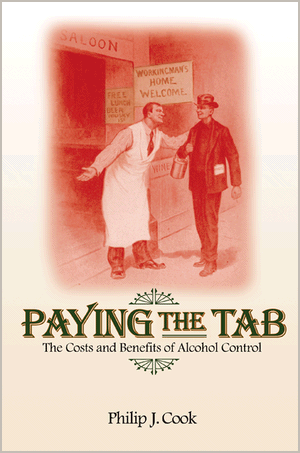
These statistics are from Paying the Tab: The Costs and Benefits of Alcohol Control by Philip Cook, a professor of Public Policy at Duke. And, I have not read the book yet.

Here are some more fascinating bits from the book which used data from a national survey that took place between 2001 and 2005: 
  • 30% of Americans don't drink at all. 
  • 30% of Americans drink at least one drink a day 
  • 20% drink at least two a day. (BTW, low-risk or moderate drinking falls somewhere between the two.) 
And according to the CDC excessive drinking costs us $223.5 billion in 2006, or about $1.90
per drink.


Definitely more to come on this fascinating topic...


Monday, September 22, 2014

All About Alcohol

Contrary to what we are led to believe, alcohol is the worst when it comes to harmful consequences. Globally it kills 2.5 million people and nationally 75,000 people die prematurely because of alcoholism and alcohol-related illnesses. It is the third leading killer globally.

An infographic from the team at Addiction Blog
Alcohol and the modern world (INFOGRAPHIC)

Here are some sobering facts about alcohol you may not have considered:

What is heavy drinking or risky drinking?
For men 14 or more units of alcohol per week.
For women, the number drops to 7.

What is a unit of alcohol?
.6 fluid ounce or 12 grams of pure alcohol, that is a 12 oz. bottle of beer, a shot of booze or a glass of wine (1/5th of a bottle).

Prolonged alcohol abuse or heavy drinking is linked to serious health risks:
  • alcoholic cardiomyopathy 
  • alcoholic liver disease 
  • decrease in bone density 
  • decrease in bone mass (leading to osteoporosis) 
  • heart arrythmias 
  • increased blood pressure 
  • increased risk of bone fracture 
  • loss of immune response 
  • stroke
But, just being drunk can be bad in the short term.
Lest we forget: alcohol costs money, it has calories, and it speeds up the ageing process.

Monday, August 4, 2014

Russell Brand on Spiritual Practice


I don't know about you but Russell Brand is difficult to ignore. He has certainly made most intimate aspects of his life public: short lived marriage to a pop star; addiction to drugs and alcohol followed by recovery. He has made a name for himself as a passionate advocate of yoga and meditation. I respect him for making statements on subjects that make people and corporations very uncomfortable. But let's not forget he is a comedian and it's their job to make us feel hot under the collar, but he does a particularly great job at it.

I am featuring the short video above, actually a compilation of clips, which showcase his view on spirituality, addiction, culture, etc... And I have to say I like what he says and how he says it. The intensity of the delivery reveals the zeal with which he once consumed alcohol, drugs and sex. It is to our benefit that he has found another outlet to sublimate or redirect his energy. And so is he. In fact, as any addict in recovery will tell you, he probably wouldn't be alive to tell it how it really is.

One more thing, addiction takes time, energy, money and effort. Which begs the question, what are you going to do instead of abusing alcohol and drugs? How are you going to fill the time which was once devoted to getting high and drunk? For many, as is the case for Mr. Brand, a spiritual practice fills that void.