I am a big proponent of journaling as a way to keep things honest between you and yourself. It's an invaluable tool that deepens self-awareness, whether or not you are in therapy.
And, there is blogging, not blogging as marketing, but personal blogging. It is a form of journaling, but it's not the lock-and-key, Dear Diary variety. Personal blogging is like keeping a journal that's meant to be read by whomever. It's personal and public at the same time.
It's therapeutic because making a declaration, which isn't exactly shouting, blogger reminds herself of who she is and what she aspires to become. It's writing for self-reflection and inviting others to witness the process, which CAN be an act of courage and commitment, or just a form of narcissism. It's much like "Hi, I am so and so, and I am an alcoholic" part of AA.
Which brings me back to sober blogging. I like this blog very much for the reasons cited above and more. I hope it can inspire others to rethink their relationship to alcohol.
http://drunkydrunkgirl.wordpress.com/2013/09/02/inspiration-to-others/
Showing posts with label Psychotherapy. Show all posts
Showing posts with label Psychotherapy. Show all posts
Monday, September 2, 2013

Tuesday, August 20, 2013
The Examined Life
Some books are to be tasted, others to be swallowed,
and some few to be chewed and digested.
Francis Bacon, the philosopher, not the painter.
and some few to be chewed and digested.
Francis Bacon, the philosopher, not the painter.

Sometimes a book can come along and make your life better. Reading
it feels as though it was meant to enter your life at that exact time.
And isn’t this why we have a life-long love affair with books?
And isn’t this why we have a life-long love affair with books?
Books can help us answer questions we haven’t yet to formulate.
At their best, they rouse us to carry on an inner dialogue and deepen our
self-awareness. And awareness is the first step in the process of change.
Yes, change is possible. It’s a slow-going, subtle shifting of your attitude, first to your self, and, over time, it will manifest outwardly in your interactions with the world.
Yes, change is possible. It’s a slow-going, subtle shifting of your attitude, first to your self, and, over time, it will manifest outwardly in your interactions with the world.
Stephen Grosz’s The Examined Life is one such book. Grosz is an American psychoanalyst based in
London. I love this book because the writing is superb; language is simple and precise, without psychological
jargons to showcase the author’s expertise. He writes for an audience interested in living a deeper, more authentic life (don’t we all?). Though I am not a book reviewer, if you are interested the literati love his book!
My
clinician self found important lessons in how to be a better therapist, both in
technique and in philosophy. And as a general reader, I very much appreciate the clinical
cases he presents, because I identify with many of the enduring “issues”
that had brought people to his office. Some of these universal themes are: the search for
and keeping of loving relationships, forgiveness, resolving the hurts from our
imperfect childhoods, loneliness, sexuality, raising children, facing
death.
If there were to be a syllabus for therapy The Examined Life would be a required reading.
Quick note about psychoanalysis: It is a type of
psychotherapy I DO NOT practice. However, I hope to start training in it in the
near future. Its aim is to affect or change the personality structure of the
client over an unspecified period of time. Usually a client brings in a complaint of a
non-urgent nature, something that nags her but does not interfere with her
overall functioning. Free association is the primary technique used in
analysis; it means that the client is encouraged to think out loud, to say whatever
comes to her mind. The analyst then interprets what was said, noting patterns
or other significant content to which the client was unaware. There is little
advice giving, and progress or insights are made by the client on their own.
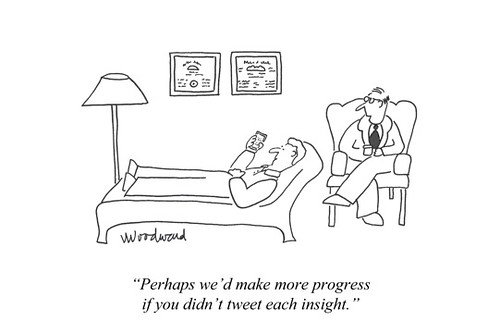
The work I do is more hands on and goal directed. The issues I
deal with tend to exist on the surface of day-to-day life, whereas psychoanalysis
deals with issues that are more deeply imbedded.
Subscribe to:
Posts (Atom)