Showing posts with label Moderate Drinking. Show all posts

Friday, September 26, 2014

Economics of Drinking

Pareto Law is a little known principle applicable to multiple disciplines. It is better known as the 80-20 rule: 80% of the effects comes from 20% of causes, or 20% of workers in an organization perform 80% of the work. 

What does this have to do with alcohol consumption? Everything, of course. 20% of Americans consume 80% of alcohol sold in the U.S. 

Check out this graphic.

Shockingly, 10% of Americans (24 million people over the age of 18) drink over 50% of all alcohol consumed in America. That averages out to 10 drinks per day or nearly 74 drinks a week (2 bottles of wine a day, or 18 bottles of wine or three 24-cases of beer per week).

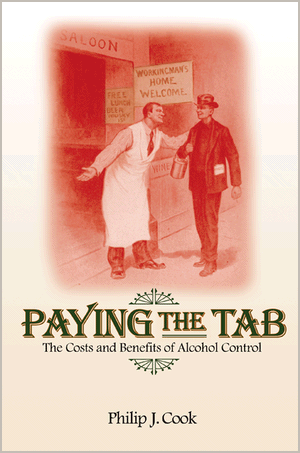
These statistics are from Paying the Tab: The Costs and Benefits of Alcohol Control by Philip Cook, a professor of Public Policy at Duke. And, I have not read the book yet.

Here are some more fascinating bits from the book which used data from a national survey that took place between 2001 and 2005: 
  • 30% of Americans don't drink at all. 
  • 30% of Americans drink at least one drink a day 
  • 20% drink at least two a day. (BTW, low-risk or moderate drinking falls somewhere between the two.) 
And according to the CDC excessive drinking costs us $223.5 billion in 2006, or about $1.90
per drink.


Definitely more to come on this fascinating topic...


Monday, September 22, 2014

All About Alcohol

Contrary to what we are led to believe, alcohol is the worst when it comes to harmful consequences. Globally it kills 2.5 million people and nationally 75,000 people die prematurely because of alcoholism and alcohol-related illnesses. It is the third leading killer globally.

An infographic from the team at Addiction Blog
Alcohol and the modern world (INFOGRAPHIC)

Here are some sobering facts about alcohol you may not have considered:

What is heavy drinking or risky drinking?
For men 14 or more units of alcohol per week.
For women, the number drops to 7.

What is a unit of alcohol?
.6 fluid ounce or 12 grams of pure alcohol, that is a 12 oz. bottle of beer, a shot of booze or a glass of wine (1/5th of a bottle).

Prolonged alcohol abuse or heavy drinking is linked to serious health risks:
  • alcoholic cardiomyopathy 
  • alcoholic liver disease 
  • decrease in bone density 
  • decrease in bone mass (leading to osteoporosis) 
  • heart arrythmias 
  • increased blood pressure 
  • increased risk of bone fracture 
  • loss of immune response 
  • stroke
But, just being drunk can be bad in the short term.
Lest we forget: alcohol costs money, it has calories, and it speeds up the ageing process.

Monday, August 12, 2013

How to Drink Moderately

These are some suggestions that I use with my clients.
By no means is the list complete. 

• Eat something before getting to the bar or party.

• Have a plan for the evening: How long will you stay?
Who are you going to be with?
Know when you will be home.
Goal is to avoid open-ended nights.

• Limit yourself to only one drink within a 30-minute period.

• Limit yourself to 4 drinks for men and 3 for women and the weekly maximum of 14 for men and 9 for women as recommended by the National Institute of Health for moderate-risk drinking.

• Know what a “drink” is. Remember, a pint is 16 ounces.
Drinks you have with dinner also count. 
  • 12 fluid ounces of beer (about 5% alcohol)
  • 8 to 9 fluid ounces of malt liquor (about 7% alcohol)
  • 5 fluid ounces of table wine (about 12% alcohol)
  • 1.5 fluid ounces of hard liquor (about 40% alcohol)


• Keep in mind BAC (BloodAlcohol Content) and think about why it’s important. Maintaining a BAC lower than .06%* is crucial to moderate drinking because our ability to reason becomes impaired at this point. It is the point of no return for problem drinkers. Even if the intention is to limit alcohol intake, if the BAC is higher than .06% you are more likely to continue drinking. Binge drinking is defined as having a BAC of .08% or higher.
*Disclaimer: these recommendations are for people who don't plan on driving a car. Remember, riding a bike under the influence is dangerous and against the law.
Drivers, please consult regulations for your state.

• Alternate between alcoholic and non-alcoholic drinks.

• Drink water in between drinks.

• Nosh on snacks while drinking. 

• Tell others, friends and acquaintances, of your intention to drink moderately, if you feel they would be supportive.

• Ask yourself what is the primary goal of the event? Is it social
or just for alcohol consumption? If it’s the latter, rethink who you are hanging out with. 

• Plan activities that don’t automatically involve alcohol.
Be creative.

• If you always drank at a certain time, for example after work, have a plan in place for those off nights. Go to the gym, go for a run or plan an outdoor activity. Go to the movies. 

• Remind yourself of the reasons why you want to drink moderately. For example, the hangover next day; money spent on drinks, cabs and food; the pride in knowing that you can practice self control.

• Practice mindfulness with alcohol. Is your goal to enjoy the taste of that IPA or red wine? How does it taste? What is its texture? Describe what you observe about your experience of drinking
and the people around you.

• Notice how alcohol affects people differently. How do you think alcohol affects you?

• Write in your journal about the experience. 

• Remind yourself that it gets easier the more you practice it.

• List the benefits of moderate drinking in the same journal.

• Know how alcohol interacts with the medications (over the counter or prescription) you take. Often, medications amplify the effects of alcohol, so let that be the guide in what moderate drinking looks like for you.


If you have other ideas, add them below.
Wednesday, August 7, 2013

Who Are These Alcoholics?

Google “alcoholic pictures” and you will find that an alcoholic tends to be an unhappy adult white male who sits in the dark with his head in his hands. He is alone and depressed with only a bottle for company.


An alcoholic, defined clinically, is someone physically dependent on (addicted to) alcohol and unable to control how much they drink; alcoholic also has cravings and increased tolerance, and goes through withdrawal symptoms when alcohol leaves their system. Comparatively, a problem drinker, or an alcohol abuser, is someone psychologically dependent on alcohol but without the physical dependence (although a hang over is a collection of moderate withdrawal symptoms). For the problem drinker, the issue isn’t alcohol (because they can go without) but the reasons why they drink and what happens after they drink.

National Institute of Health and National Institute of Alcohol and Alcohol Abuse classified U.S. alcoholics into five subtypes. These results are from a 2007 national survey, and it is estimated 14 million Americans qualify as alcoholics.

Young Adult subtype: largest group in the U.S. with 31.5 percent of alcoholics. Low rate of mental illness, drug abuse and history alcoholism in their families. Least likely to seek out help.

Young Antisocial subtype: In their mind-twenties, 21 percent of U.S. alcoholics. Early onset of alcohol use and problems related to alcohol abuse. More than half from families with alcoholics. About half are diagnosed with Antisocial Personality Disorder. Many suffer from the trinity of mental illness (depression, bipolar disorder and anxiety problems). More than 75 percent smoke cigarettes and marijuana, and many have problems with cocaine and opiates. More than a third seek help.

Functional subtype: 19.5 percent of alcoholics. They are mostly middle-aged, well-educated, with stable jobs and families. Third have alcoholism in their family histories, a quarter had major depression at some point in their lives, and nearly half were smokers of tobacco.

Intermediate Familial subtype: 19 percent of American alcoholics, they are middle-aged and half withs familial history of alcoholism. Most smoked, half of them had clinical depression, and 20% have had bipolar disorder. Nearly 20% had problems with cocaine and marijuana. In this group only a quarter get treated.

Chronic subtype: 9 percent of U.S. alcoholics. Middle-aged; began drinking heavily at an early age. High rates of Antisocial Personality Disorder and criminality. Highest rate of mental illness (depression, bipolar disorder, anxiety disorder). High rates of smoking, marijuana, cocaine, and opioid dependence. 2/3 of the group get help (many of them to mandated to treatment making them the most prevalent type found in treatment.


Information, which I summarized here, comes from:

http://www.news-medical.net/news/2007/06/29/27074.aspx?page=2

http://www.alcoholic.org/research/alcoholism-statistics-and-information/


Are you an alcoholic? Find out here

In my practice I work to help problem drinkers with their emotional health, in addition to learning how to become a more mindful, moderate drinker.


Friday, April 12, 2013

Tuesday, February 5, 2013

Rethinking How and Why You Drink


I’ve tried to define risky or heavy drinking in a prior post. Naturally, a post on why one may want to consider cutting back or drink moderately follows.

First, I’d like to distinguish alcoholism from alcohol abuse,
i.e. risky/heavy drinking, by making the distinction between physical dependence on alcohol from psychological dependence.

I am primarily concerned with psychological dependence and its relationship to emotional health. 

The following are the most common reasons/beliefs why people say they drink:

1. Alcohol makes me feel less shy and more social
2. Drinking alcohol makes socializing more fun
3. I am more interesting and fun to be with when I am drinking
4. I am more myself when I am drinking
5. Alcohol relaxes me
6. Alcohol unwinds me from stresses of life
7. Drinking makes me forget my troubles
8. I am more creative when I am drinking

These reasons, for the most part, are valid and supported by the fact that alcohol has been around just as long as we have. There is no denying that ethyl alcohol, the active chemical compound in alcohol, does relax the brain and body, initially.

One possible explanation for how drinking becomes problematic maybe because of habits. Once we hold an idea of ourselves to be true – I am more social and friendly after a couple of beers or alcohol helps me to relax – the repetition of the behavior, or the habit, reinforces the belief which first initiated the behavior. We begin to believe that drinking alcohol is the ONLY way we can be relaxed, be more social and have fun in a social setting. In a sense, we become trapped by the beliefs we have about ourselves. We become the person who we believe we are.

But we can’t be sure this is true, even though it may have been true in high school or college when we first started drinking. But, we can discover new parts of ourselves by doing the same things differently or trying new things.

By questioning established beliefs or behaviors and trying new ideas, we learn new aspects of our personalities, expanding our idea of who we are. As our self-image or self-concept expands, so does our self-esteem, which makes incorporating new ways of thinking and behaving easier.

Practical application of this theory to problem drinking would be to see how it feels to go out and not drink or limit how much you drink so that you don’t go beyond the threshold where alcohol influences your ability to make decisions. 

I recommend to my clients who have identified heavy drinking as a problem to abstain from alcohol for 30 days. During these 30 days, they are encouraged to think deeply about their relationship to alcohol and decide how they might go about changing it. They may decide to stop drinking all together or try to moderate their drinking.

This period of self reflection is not an easy one. Many people will give up, because it would mean dealing with their anxiety and depression. It is demanding work, and change does not take place over night.

To be continued...