Friday, September 26, 2014

Economics of Drinking

Pareto Law is a little known principle applicable to multiple disciplines. It is better known as the 80-20 rule: 80% of the effects comes from 20% of causes, or 20% of workers in an organization perform 80% of the work. 

What does this have to do with alcohol consumption? Everything, of course. 20% of Americans consume 80% of alcohol sold in the U.S. 

Check out this graphic.

Shockingly, 10% of Americans (24 million people over the age of 18) drink over 50% of all alcohol consumed in America. That averages out to 10 drinks per day or nearly 74 drinks a week (2 bottles of wine a day, or 18 bottles of wine or three 24-cases of beer per week).

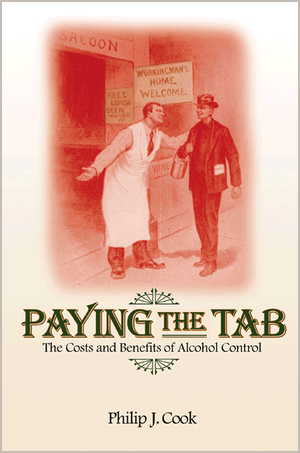
These statistics are from Paying the Tab: The Costs and Benefits of Alcohol Control by Philip Cook, a professor of Public Policy at Duke. And, I have not read the book yet.

Here are some more fascinating bits from the book which used data from a national survey that took place between 2001 and 2005: 
  • 30% of Americans don't drink at all. 
  • 30% of Americans drink at least one drink a day 
  • 20% drink at least two a day. (BTW, low-risk or moderate drinking falls somewhere between the two.) 
And according to the CDC excessive drinking costs us $223.5 billion in 2006, or about $1.90
per drink.


Definitely more to come on this fascinating topic...


Monday, September 22, 2014

All About Alcohol

Contrary to what we are led to believe, alcohol is the worst when it comes to harmful consequences. Globally it kills 2.5 million people and nationally 75,000 people die prematurely because of alcoholism and alcohol-related illnesses. It is the third leading killer globally.

An infographic from the team at Addiction Blog
Alcohol and the modern world (INFOGRAPHIC)

Here are some sobering facts about alcohol you may not have considered:

What is heavy drinking or risky drinking?
For men 14 or more units of alcohol per week.
For women, the number drops to 7.

What is a unit of alcohol?
.6 fluid ounce or 12 grams of pure alcohol, that is a 12 oz. bottle of beer, a shot of booze or a glass of wine (1/5th of a bottle).

Prolonged alcohol abuse or heavy drinking is linked to serious health risks:
  • alcoholic cardiomyopathy 
  • alcoholic liver disease 
  • decrease in bone density 
  • decrease in bone mass (leading to osteoporosis) 
  • heart arrythmias 
  • increased blood pressure 
  • increased risk of bone fracture 
  • loss of immune response 
  • stroke
But, just being drunk can be bad in the short term.
Lest we forget: alcohol costs money, it has calories, and it speeds up the ageing process.

Monday, August 4, 2014

Russell Brand on Spiritual Practice


I don't know about you but Russell Brand is difficult to ignore. He has certainly made most intimate aspects of his life public: short lived marriage to a pop star; addiction to drugs and alcohol followed by recovery. He has made a name for himself as a passionate advocate of yoga and meditation. I respect him for making statements on subjects that make people and corporations very uncomfortable. But let's not forget he is a comedian and it's their job to make us feel hot under the collar, but he does a particularly great job at it.

I am featuring the short video above, actually a compilation of clips, which showcase his view on spirituality, addiction, culture, etc... And I have to say I like what he says and how he says it. The intensity of the delivery reveals the zeal with which he once consumed alcohol, drugs and sex. It is to our benefit that he has found another outlet to sublimate or redirect his energy. And so is he. In fact, as any addict in recovery will tell you, he probably wouldn't be alive to tell it how it really is.

One more thing, addiction takes time, energy, money and effort. Which begs the question, what are you going to do instead of abusing alcohol and drugs? How are you going to fill the time which was once devoted to getting high and drunk? For many, as is the case for Mr. Brand, a spiritual practice fills that void.


Tuesday, July 29, 2014

Anxiety in Choosing

Whether you are looking to purchase your first home, choosing an outfit for that first date or job interview, or deciding to marry or move-in together with your boyfriend or girlfriend, making decisions can be a harrowing process.

If the decision involves a lot of money it will raise all sorts of associated worries. Do I have enough money? Will I have to cut back on something else to cover the investment? If something goes wrong what will happen to my future? Will I become homeless or need to work two jobs?

If you need to decide the fate of a romantic relationship, anxieties in the form of ambivalence may rise. You can love and feel affection for someone while secretly harboring concerns about them: Will they become financially and emotionally dependent on me? Will their quirks become full-blown craziness down the road? What sort of parents are they going to become? Will they become their parents?

Ambivalence is the experience of feeling two opposing emotions simultaneously. The ambivalent partner may feel weighed down by guilt and confusion: If I really loved this person I shouldn't be feeling this way... so the thought goes. But is there anything in life that is wholly black and white?

The fact is we are constantly choosing. We make decisions each and every moment. We don't notice because for the most part these decisions are miniscule and inconsequential: a poorly thought-out outfit probably isn't going to affect your future too much. Also, when we make the same decision repeatedly (mindlessly, without thinking) we forget we are choosing.

One aspect of being a mature human being is that inevitably we have to make a big decision that will affect the rest of our lives. The option to not choose is really not an option (remember Bartleby the Scrivener?).  The other option is to live off the grid and live independently, freed from social conventions and modern amenities.

Here is a very good piece of marketing — profound and entertaining at the same time!


More on decisions and decision-making process later.

P.S. I condone moderate drinking, as does Jim Beam and Willem Dafoe, I am sure.


Sunday, May 4, 2014

Peaches Update: Death from Heroin OD

This is a follow up post to an earlier post on the tragic death of Peaches Geldof at age 25 with her young child next to her. I had played celebrity death sleuth but was incorrect in my assessment.

Legacy of addiction gets handed down like family estates and jewelry. Her mother overdosed at age 41 with a child at her side, and our Peaches recreates the scene 14 years later, except she was only 25.

Do we all become our parents? I think not.
Are we helpless to go on repeating the past, whether it is an addiction or a pattern of thinking and behaving?

This is why therapy needs to be part of every recovery process. Addiction isn't just the physical and psychological dependence. There exists a core conflict, our defining wound which originates in childhood. The resulting pain, whether psychological or spiritual or both, is what we attempt to dull with our substance(s) of choice.

Through therapy and/or spiritual reflection, we can become more aware, more in tune with our subconscious, so that we are less likely to act out, or behave unconsciously, and repeat what we know or become the parents whom we feel let us down.

http://www.thefix.com/content/peaches-geldof-reportedly-died-heroin-overdose