Friday, January 31, 2014

Binge Drinking Is Killing Russians

http://usa-moscow.blogspot.com/
If you need proof that alcoholism is a killer, you need to look no further than what was reported today on the BBC.

According to a national study cited in the article, 25% of Russian men die before age 55 from drinking too much. I quickly did the math, and it means nearly 180,000 men. Total population of Russia is 142 million.

The causes of death were liver disease and alcohol poisoning. And drunken fights and accidents were also mentioned.

Here is the link to the article with disturbing details of what is basically a national tragedy.

http://www.bbc.co.uk/news/health-25961063


Thursday, January 23, 2014

Depression Is a Flaw in Love


I can't say enough about this clip of Andrew Solomon speaking about depression from a TED Talks from December 2013. 

It requires amazing courage to write about one's experience with severe depression, or in his words "an illness of how you feel." 

Nevertheless, it is an illness; he reminds us that it is the leading disability world wide, and people die of it every day.

Here are some extraordinary bits of wisdom I will always want to remember.

  • Opposite of depression isn't happiness. Vitality is its opposite. 
  • Depression is a flaw in love.
  • Quote from another sufferer: Depression is "a slower way of being dead."
  • True clinical depression is characterized by delusional perceptions.
  • For the depressed, truth lies. An example: We will all die eventually, but it's not necessary that we dwell on it because it keeps us from living.
  • Our needs are our biggest assets. I hope to experience this some time soon.
  • What are our treatment options for depression? Chemical cure or psychological cure?
    Neither are very effective and inaccessible to the poor, who are more likely to suffer from depression as a result of poverty-created environmental stressors.
  • Treatment for depression (talk therapy) is expensive.
  • Side effects from antidepressant medications keep people away from its imperfect solution, even though many people do benefit from pharmacotherapy.
  • Sadness, grief and depression are often confused. Grief is a reactive response to loss, which resolve over time. Time heals.
  • Sadness is sadness. But depression is much too much sadness.
  • Depression can be triggered by catastrophic loss.

    http://andrewsolomon.com/


Monday, January 20, 2014

Addiction to Money


Usually in these pages I don't talk about addiction to money. My experience with addiction has been mostly with abuse of substances one ingests. 

There is another subset in the field around process or behavioral addictions. We are talking about compulsive behaviors such as sex addiction, gambling addiction and addiction to making money. 

Years ago I simply called it greed, but after reading this thought-provoking piece in the Times I see how it is an addiction.

The author connects the out-of-control need to earn an absurd amount of money on Wall Street to his an earlier history of alcohol and drugs abuse. With the help of his counselor, he came to see that it wasn't so much about the money (millions of it) but what it represented — the desire for power — subconscious need to feed an emotional hunger that originated from his childhood and maybe even inherited from his father. 

I've been meaning to read and write about Gabor Mate, an addictions doctor, who believes that at the root of all addiction is hunger — emotional or spiritual hunger (so did Jung, by the way). 

So what is it  we hunger for? And how do we go about filling the void? 
Which maladaptive behaviors are compulsively and guiltily engaging it?
Which substances are we ingesting to 
self-medicate? 

What's more distressing is that our market system is being driven by a bunch of sociopathic money addicts whose compulsive need for power causes people to suffer, not just in this country, but also around the world.

http://nyti.ms/1cGibh1

Thursday, January 16, 2014

Living in an Age of Anxiety

Each of us has an intimate knowledge of anxiety in its many forms and subtle qualities. 
  • Apprehension
  • Fear
  • Distress
  • Uneasiness
  • Disquiet
  • Agitation
  • Upset
  • Worry
  • Torment
  • Fretting
  • Angst
  • Foreboding
  • Misgiving
  • Tension
  • Stress
  • Nervousness
  • Dread
The list is by no means comprehensive. We can certainly add other words to describe our particular experience of what it's like to be anxious.

Not surprisingly, it’s now the most commonly diagnosed mental disorder. As a result, it’s been talked about and written about everywhere. New York Times ran an opinion section called Anxiety, which published 70 pieces that ended last summer. 

Saturday, December 28, 2013

Picturing Addiction: The Work of Chris Arnade

Chris Arnade
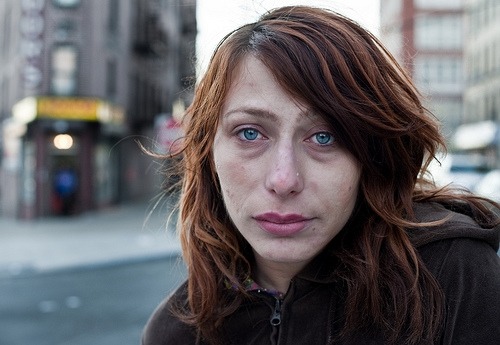
It’s not uncommon to encounter ruinous examples of drug addiction in New York City on a daily basis. When I see grimy, young opiate addicts nodding out on the sidewalk middle of the day or aggressively panhandling, often with their dogs, even though I am substance abuse counselor it’s difficult to feel empathetic. 

Even the most compassionate of us flinch with judgment and hopelessness when confronted with such characters. It looks as if the most seriously addicted — street addicts  have refused help. The assumption is that they have given in to their addiction; they have resigned themselves to the misery of their situations. 

Chris Arnade, the street photographer/activist, focuses mostly on individual addicts and sex workers who stay/work around Hunt’s Point in the Bronx, an area not likely to be in any New York City travel guide. His work is similar to social documentary photographers like Jacob Riis and Lewis Hine, who used photography to expose social problems affecting the poor and the exploited. Likewise, Arnade’s work makes us take account of individuals whom we choose to not see. Considering street addicts as a group conveniently minimizes the problem of drug addiction. Arnade’s startling portraits and text makes us see individuals. His work humanizes a group of people who makes us uncomfortable. We find that we can identify with their desire for a better future.